Executive Summary
The Business Case STACK matters because preconstruction is where price, scope, and competitive position are decided — and it's historically manual, brittl...
When bids bleed time and margins evaporate: why STACK deserves a second look
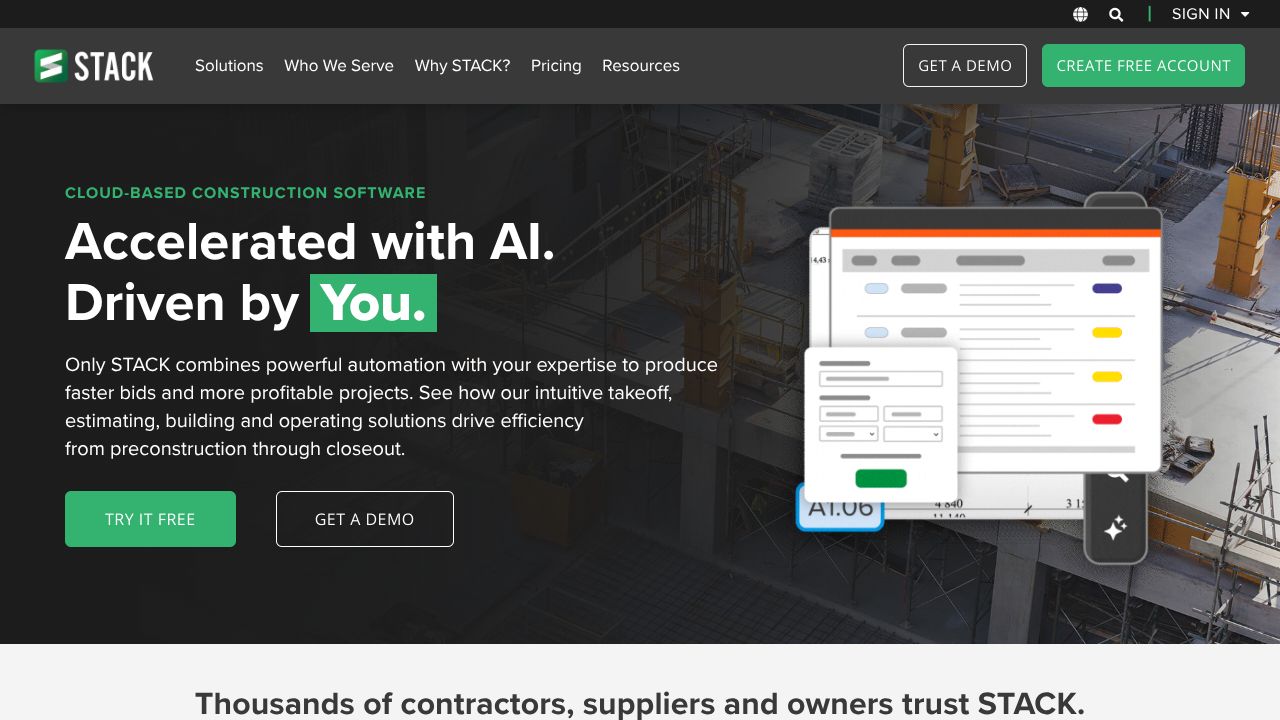
You know the scene—estimators hunched over PDFs, toggling between zoom and measurement tools, missing a markup, and watching a profitable job turn into a break-even exercise. STACK is cloud-based, AI-enhanced takeoff and estimating that speeds plan measurements, houses cost databases, and spits out proposals. For SaaS leaders evaluating adjacent markets, partnerships, or product benchmarks, the bottom line is simple: STACK proves a focused, well-priced vertical SaaS play that turns preconstruction chaos into repeatable margin control.
The Business Case
STACK matters because preconstruction is where price, scope, and competitive position are decided — and it's historically manual, brittle, and under-digitized. By automating measurements and centralizing cost databases with cloud access and mobile web apps, STACK shortens bid cycles and reduces human error in quantity takeoffs. That translates directly into measurable ROI: fewer lost bids due to late proposals, lower labor hours per estimate, and faster time-to-proposal that increases quote volume. At $49–$149 per month, STACK’s pricing sits squarely in the “accessible at scale” bracket for subcontractors, enabling broader adoption without enterprise procurement friction. For SaaS leaders, it's a compact case study in product-led growth in vertical markets: targeted feature set, low friction onboarding, and clear monetizable value. My hot take — if you want to see how a narrow, operationally focused SaaS product builds defensibility, STACK is the blueprint: fast time-to-value, recurring revenue at sensible ARPUs, and meaningful operational ROI for customers.
Key Strategic Benefits
-
Operational Efficiency: STACK compresses takeoff workflows by centralizing measurements and automating routine calculations; teams can turn around proposals faster and with fewer rework cycles. In my experience, shaving hours off an estimator’s day compounds quickly across a bidding slate.
-
Cost Impact: By standardizing cost databases and speeding proposal generation, STACK reduces labor costs per bid and helps firms bid more competitively without sacrificing margins. The predictable subscription pricing keeps vendor costs from ballooning as usage scales.
-
Scalability: Cloud delivery and a mobile web app mean teams can scale usage across projects and users without heavy IT lift. The modular nature of takeoff → cost DB → proposals supports staged adoption by firms of different sizes.
-
Risk Factors: Reliance on accurate cost databases means poor data hygiene undermines benefits; leaders must invest in governance. Also, while STACK reduces manual measurement risk, integration gaps with legacy ERP/estimating systems can create noisy handoffs during deployments.
Implementation Considerations
Plan for a 4–12 week roll-out depending on scope. Start with a pilot team handling a representative project mix to validate time-to-proposal and measurement accuracy improvements. Resources needed: a product owner in estimating, an integration lead for ERP/accounting hookups, and a small change-management push to standardize cost codes and templates. Expect initial data work to align cost databases to your chart of accounts; this is the most time-consuming but highest-leverage task. Training should be lightweight — STACK’s mobile web app model favors short, practical sessions—yet reinforcement through real projects is essential. Integrations matter: map how proposals flow into CRM/ERP and whether SKUs or assemblies need normalization. Lastly, set KPIs from day one: bids per estimator per month, average turnaround time, win rate, and cost-per-bid. Those metrics turn STACK from “nice tool” into a business case with measurable ROI.
Competitive Landscape
STACK sits in a specialized niche and compares differently depending on the competitor. While Smartvid.io excels at AI-driven photo and video analysis for safety and risk management, STACK is better suited for preconstruction estimating and proposal generation — they solve adjacent but distinct problems. Similarly, Buildots focuses on turning on-site progress data into actionable analytics for construction execution; it’s stronger for real-time site monitoring, whereas STACK wins in prebuild measurement and cost capture. Oddly enough, tools like Metricool sit in a different analytical lane (marketing analytics and scheduling), but the comparison is useful: Metricool scales volume-driven analytics for marketing teams, while STACK scales repetitive, operational workflows for trades. Pricing is a differentiator — STACK’s $49–$149/month range positions it as high value for money relative to more specialized or execution-stage platforms. Competitors bring stronger capabilities in safety analytics or site-capture, but few match STACK’s combination of focused feature set, ease of onboarding, and accessible pricing for subcontractors.
Recommendation
If you lead a SaaS org evaluating vertical expansion, partnership, or M&A, prioritize a pilot integration with STACK to validate operational uplift metrics (time-to-proposal, bids per estimator, win rate). For construction operators, deploy a 6–8 week pilot with a clean cost DB and a single estimator cohort, track KPIs, and plan ERP mapping early. Assign an owner to data governance and make the pricing case: at $49–$149/month, the threshold for adoption is low — measure, iterate, and scale. I’d bet on this approach: small pilots, crisp metrics, and rapid expansion if ROI is proven.
Learn More About STACK
Visit the official website for additional documentation and resources.
Visit Website