Executive Summary
Quick Comparison Table...
When pentest PDFs feel like ancient artifacts: who actually runs security like a product?
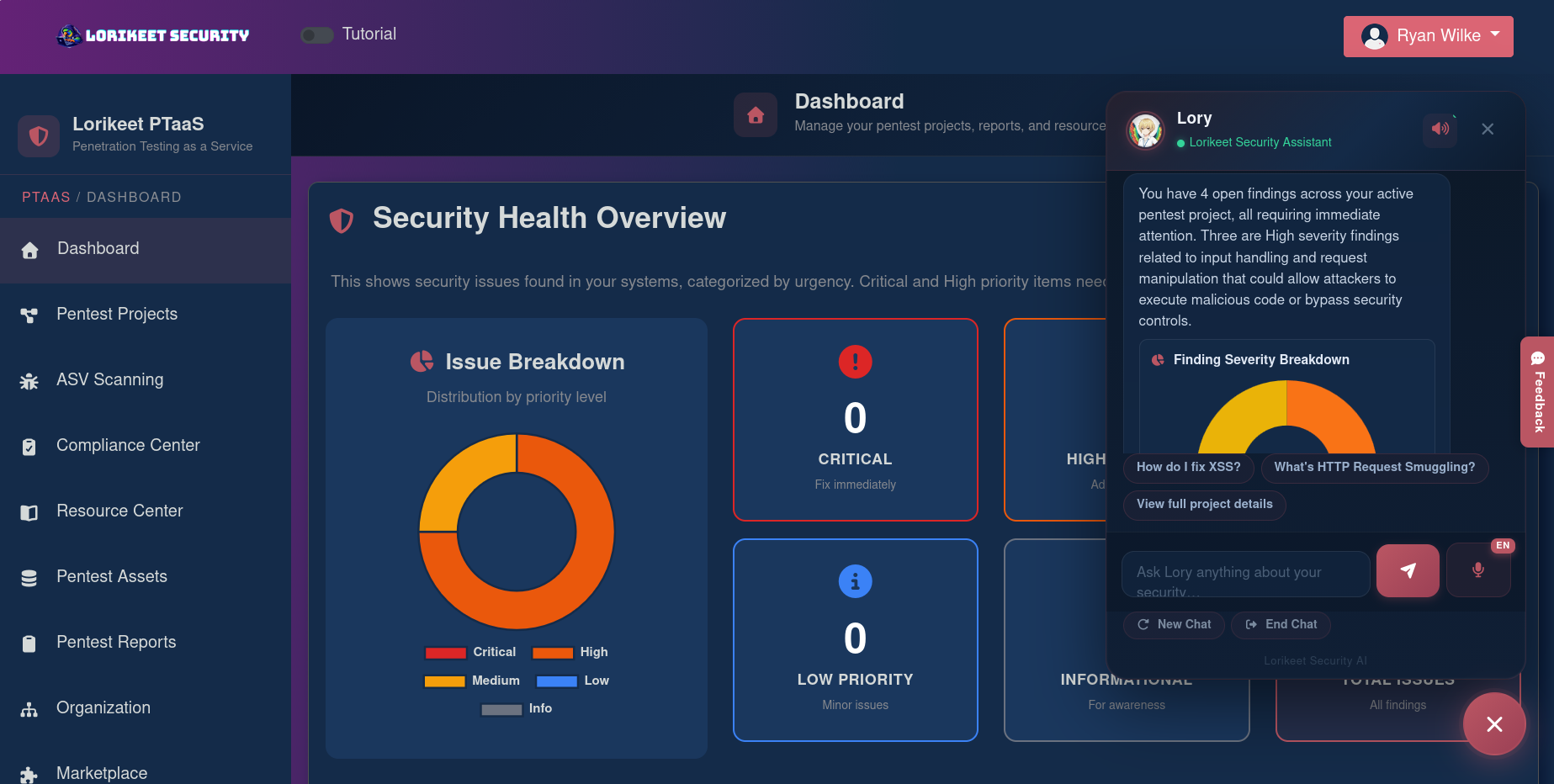
You know the scene — you pay for a penetration test, get a 50-page PDF that sits in Google Drive unread, and three months later the same bug pops up in a sprint retro. SaaS teams need continuous, operational security, not one-off artifacts. That’s the gap Lorikeet Security tries to close: a full offensive-security program (pentests + continuous ASM + compliance + training) delivered through a live portal and an AI assistant. It’s less “here’s a report” and more “here’s a security program you can actually use.”
Quick Comparison Table
| Feature | Lorikeet Security | Flowtriq | Tenable |
|---|---|---|---|
| Pricing | Engagement-based + subscriptions for continuous services and managed offerings (custom) | Typically protection tiers / mitigation plans (performance-oriented pricing) | License/subscription for scanning and platform access |
| Ease of Use | Real-time portal, Lory AI assistant, developer & auditor-friendly remediation | Simple to deploy for DDoS protection; minimal ops once configured | Familiar scanning dashboard; can be noisy without tuning |
| SaaS Features | Pentests (apps, APIs, infra, red team), 24/7 attack surface monitoring, compliance automation, training | DDoS detection + auto-mitigation (seconds) — focused service | Continuous vulnerability scanning, asset inventory, prioritization |
| Integration Options | Vanta/Drata partners, audit integrations, CI/CD workflows, retesting | Network-level integration, CDN/load balancer tie-ins | SIEM, ticketing, orchestration tools |
Where Lorikeet Security Wins
1) Platform-first offensive security. Many pentest vendors hand you a PDF and disappear. Lorikeet gives you a live portal with continuous attack surface monitoring and Lory — an AI assistant trained on ~2,000 vulnerability entries. As someone who’s wasted afternoons digging through PDFs, this is a game-changer: you track remediation progress in real time and validate fixes with included free retests.
2) Breadth of manual coverage. Lorikeet’s human-first promise — 100% manual testing across web apps, APIs (REST/GraphQL/SOAP), mobile and desktop apps, cloud infra, AD, containers, and specialized areas like IoT, blockchain, and AI-agent security — is rare. If you need high-signal findings and developer-facing remediation steps (not scanner noise), they beat pure-play scanners like Tenable on signal quality and context.
3) Compliance + attestation continuity. If you’re a SaaS company chasing SOC 2, PCI, ISO, or niche regs (DORA, NIS2, Google CASA/MASA), Lorikeet doesn’t stop at findings — they integrate compliance automation (Vanta, Drata) and can take you to attestation through partners. For teams balancing product launches with audit timelines, that single-vendor path reduces friction.
Where Competitors Have an Edge
DDoS and edge protection: If your primary threat is volumetric attacks or you need instant, automated mitigation to protect uptime, Flowtriq is purpose-built for that — it detects and mitigates DDoS in seconds. Lorikeet is not a substitute for real-time network scrubbing.
Continuous agent-based coverage and scale: Tools like Tenable (and endpoint players) are optimized for broad, continuous scanning and asset inventories at scale. If you want automated continuous telemetry across thousands of endpoints with mature integration into SIEMs, a dedicated scanning platform may be easier to operationalize initially.
Best Use Cases for SaaS
Choose Lorikeet Security when:
- You need manual, high-fidelity pentests with developer-grade remediation and free retesting.
- Your roadmap includes compliance attestation and you want a single engagement path from pentest to audit.
- You want an integrated security program: ASM, training (including phishing simulations and Parrot CTFs), and managed remediation support.
Choose Flowtriq when:
- Your primary problem is blocking DDoS and keeping customer-facing services online at all costs.
Choose a scanner (e.g., Tenable) when:
- You need broad, automated continuous scanning across lots of assets and want to feed telemetry into an existing SOC stack.
The Verdict
I run security conversations for startups all the time: if you’re a SaaS firm looking to mature security beyond compliance checkboxes — manual, contextual findings, an operational portal, and audit-ready workflows — Lorikeet is a smart bet. It won’t replace specialized edge/DDoS providers like Flowtriq, nor will it fully replace agent-based vulnerability management at massive scale, but it gives you the offensive muscle and compliance runway most early-stage and scale-stage SaaS teams desperately need. My hot take: use Lorikeet for signal and program ownership, stitch in a DDoS/edge vendor if you serve high-traffic public endpoints, and reserve scanner tooling for continuous telemetry in the background. That combo keeps execs happy and engineers productive — and my inbox a lot calmer.
Learn More About Lorikeet Security
Visit the official website for additional documentation and resources.
Visit Website