Executive Summary
Most enterprise security vendors want you to believe that the only way to stop a DDoS attack is to throw a massive, six-figure hardware appliance or a bloa...
Most DDoS Protection is Just Expensive Over-Provisioning. Here’s a Leaner Way.
Most enterprise security vendors want you to believe that the only way to stop a DDoS attack is to throw a massive, six-figure hardware appliance or a bloated "always-on" proxy at the problem. They sell you on "infinite capacity" while charging you for every gigabit of clean traffic. It’s a racket. In my eight years of building SaaS, I’ve learned that the most elegant solutions aren’t the ones that build the biggest walls, but the ones that react the fastest.
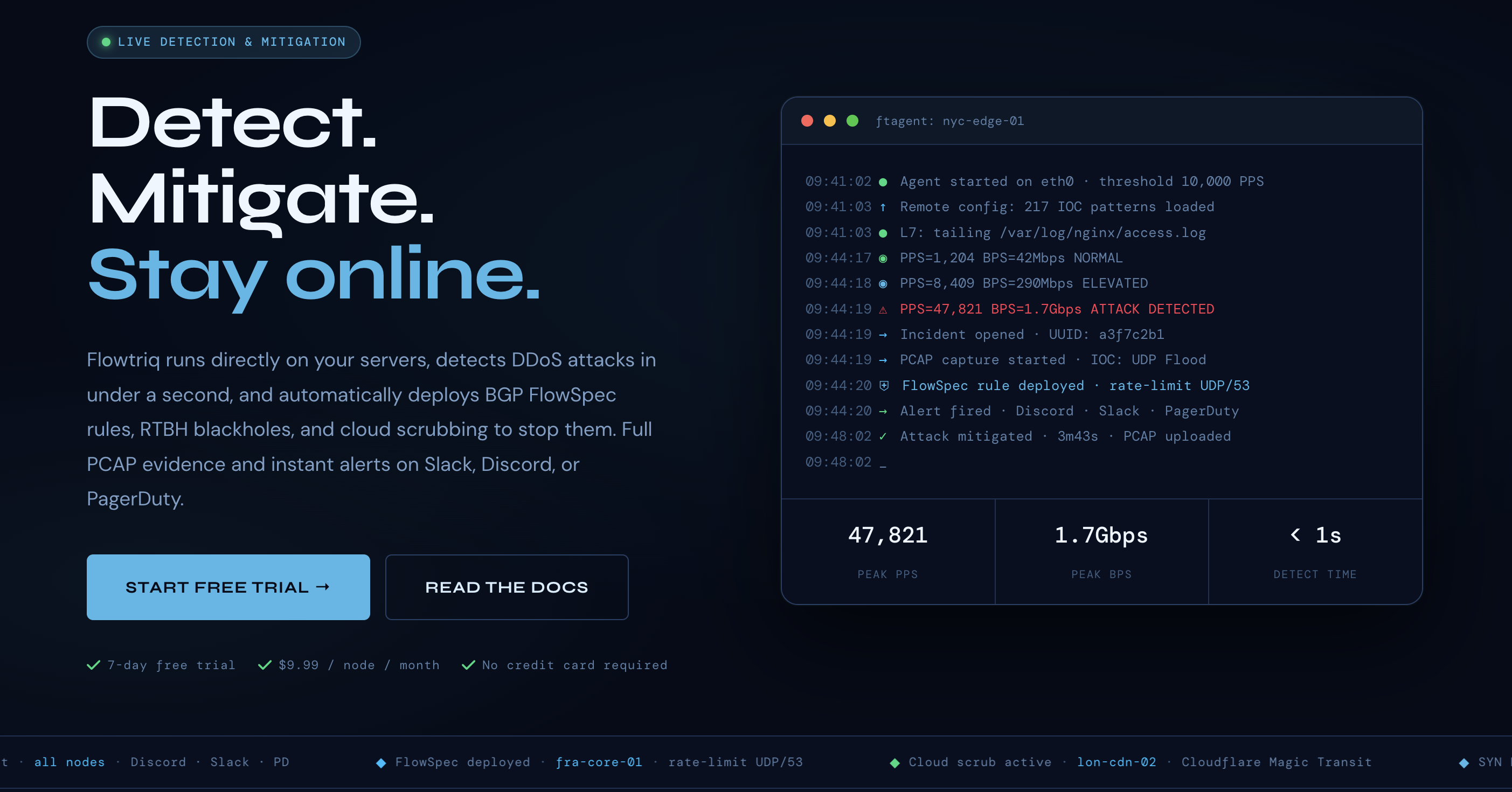
Flowtriq is a lightweight, agent-based platform that flips the script on traditional mitigation. Instead of rerouting all your traffic through a central bottleneck, it uses a distributed Python-based agent (ftagent) that installs directly on your Linux nodes. It’s designed for the "move fast and don't break things" crowd—hosting providers, game studios, and SaaS bootstrappers who need sub-second detection without the enterprise tax.
The "Zero-Tuning" Architecture: Packet-Level Intelligence
The core philosophy behind Flowtriq is decentralization. While legacy systems rely on NetFlow samples (which can miss short, "bursty" attacks), the ftagent reads packets directly from the Network Interface Card (NIC). This isn't just a high-level overview; we’re talking about granular, per-packet inspection.
The architecture is split into a local detection engine and a centralized cloud dashboard. The agent handles the heavy lifting—calculating Packets Per Second (PPS) every single second and comparing it against a dynamic, self-learning baseline. When an anomaly is detected, the agent doesn't wait for a human to finish their coffee. It executes pre-defined escalation policies, which can range from local iptables drops to broadcasting BGP FlowSpec rules or triggering external cloud scrubbing. By pushing the detection to the edge (the actual server), Flowtriq eliminates the latency inherent in centralized monitoring.
Feature Breakdown
Core Capabilities
- Sub-Second Classification & Auto-Mitigation: Flowtriq identifies over eight attack vectors—including SYN floods, UDP amplification, and complex Layer 7 application attacks—in under 1,000ms. For a game server operator, this is the difference between a minor lag spike and a total lobby collapse.
- IOC Pattern Matching: The platform correlates incoming traffic against a massive database of over 642,000 Indicators of Compromise (IOCs). This includes specific signatures for Mirai botnet variants, allowing the system to drop malicious packets before they even hit the application stack.
- Automated Forensic PCAP: The moment an attack is flagged, Flowtriq triggers an automatic Packet Capture (PCAP). This is a godsend for post-mortem analysis. Instead of wondering what hit you, you have the raw data ready for inspection in their integrated PCAP analyzer.
The Integration Ecosystem
Flowtriq is built for the modern DevOps stack. It doesn't live in a silo. The platform supports multi-channel alerting via Discord, Slack, PagerDuty, and OpsGenie, with hooks that fire within a second of detection. If you’re running a complex infrastructure, you can chain mitigation steps into "Playbooks." For example, if a node is under a massive 100Gbps volumetric attack, the playbook can automatically trigger Cloudflare Magic Transit or OVH VAC scrubbing via API, ensuring your upstream isn't choked while keeping your services online.
Security & Compliance
For the "Enterprise" in Enterprise Tech Digest, Flowtriq offers an immutable audit log—critical for compliance-heavy industries like fintech. Every action taken by the agent or a user is recorded and cannot be altered. While the agent is lightweight, the security is heavy; they’ve even contributed to the broader community by discovering the Mirai botnet kill switch (CVE-2024-45163). Data retention for PCAPs can be extended to 365 days on enterprise plans, meeting most regulatory requirements for incident logging.
Performance Considerations: The "No-Bloat" Promise
As someone who has spent too many nights debugging why a "security agent" is eating 40% of my CPU, I appreciate Flowtriq’s footprint. The Python-based agent is optimized for minimal overhead. Because it’s monitoring PPS and matching patterns rather than performing deep packet inspection (DPI) on every single payload byte in a non-malicious state, the resource usage remains negligible during "peace time." Even during an active "war time" mitigation, the focus on BGP FlowSpec and RTBH offloads the heavy lifting to the network layer rather than the server’s CPU.
How It Compares Technically
In the world of DDoS protection, you generally choose between "The Big Iron" or "The Cloud Shield."
- Flowtriq vs. Traditional Appliances: Unlike hardware from vendors like Netscout or Arbor, Flowtriq requires zero CapEx and installs in two minutes.
- Flowtriq vs. Cloud-Only Scrubbing: While services like Cloudflare are excellent, they can be expensive if you need more than basic protection. Flowtriq provides the logic to decide when to use that expensive scrubbing, potentially saving thousands in overage fees.
If you're looking for a broader look at how this fits into the security landscape, check out our deep dives on Cloudflare for global CDN-based protection or CrowdSec for collaborative firewalling.
Developer Experience
The onboarding is refreshingly blunt: a single command line to install the agent. The documentation is written for humans, not lawyers, and the inclusion of free tools like the BGP FlowSpec builder and iptables generator shows they actually understand the day-to-day pain of a sysadmin. The dashboard provides a "single pane of glass" for multi-node management, which is essential if you're managing a fleet of edge nodes or game servers across different data centers.
Technical Verdict: A Bootstrapper’s Shield
Flowtriq is the "anti-enterprise" enterprise tool. It provides the high-end detection capabilities of a SOC (Security Operations Center) at a price point ($9.99/node) that won't kill your margins.
Strengths:
- Incredible speed-to-mitigation (sub-1 second).
- No "traffic tax"—you pay per node, not per GB.
- Automated forensics with PCAP triggers.
Limitations:
- Requires a Linux environment (no native Windows agent yet).
- The $9.99 tier has limited PCAP retention compared to the Enterprise plan.
Ideal Use Case: If you are running a SaaS on bare metal or VPS, or managing a high-packet-rate environment like a game server, Flowtriq is a no-brainer. It’s the closest thing to "set it and forget it" DDoS protection I’ve seen in a long time. Now, if you'll excuse me, I have a kickboxing session to get to—I prefer my hits to be physical, not digital.
Learn More About Flowtriq
Visit the official website for additional documentation and resources.
Visit Website